

After a serious truck accident in Sterling Heights, the trucking company may begin protecting itself within hours by gathering records, interviewing witnesses, and involving its insurer or defense team.
A Sterling Heights truck accident lawyer at Goodman Acker can act quickly to preserve truck data, identify liable parties, and pursue compensation for crashes involving semi-trucks, 18-wheelers, delivery trucks, and other commercial vehicles across Macomb County.
Call 248-483-5000 to speak with an attorney before key records are lost or the carrier controls the claim.
Why Truck Crash Claims in Macomb County Require a Different Legal Playbook
 Truck accident litigation operates under a separate set of rules from a standard car crash case. Federal regulations, multiple insurance policies, and corporate defendants with in-house legal teams all change how these claims develop.
An attorney who handles truck accident cases in Sterling Heights, MI must know how to work within that framework from the first day.
The Trucking Company Already Has Lawyers Involved
Large carriers and their insurers activate rapid response protocols after a serious crash. That means defense attorneys, adjusters, and accident reconstruction consultants may arrive at the scene before you even leave the hospital.
The trucking company’s legal team starts building its defense immediately, and anything they collect during those early hours becomes part of their case against you.
We match that urgency. When a client contacts us after a truck collision in Macomb County, we move to preserve evidence the same day.
That includes sending spoliation letters to the trucking company demanding they retain ELD data, dashcam footage, driver qualification files, and vehicle maintenance records.
Goodman Acker’s Truck Accident Results
Our attorneys recovered a $2 million truck accident verdict in Oakland County and a $1.425 million settlement for a client T-boned at full speed by a semi that ran a red light in Macomb County.
Although past results do not guarantee future outcomes, those cases required us to go head-to-head with corporate defense teams and national insurance carriers.
We handle truck accident claims on a contingency fee basis, and you pay no attorney fees unless we recover compensation for you.
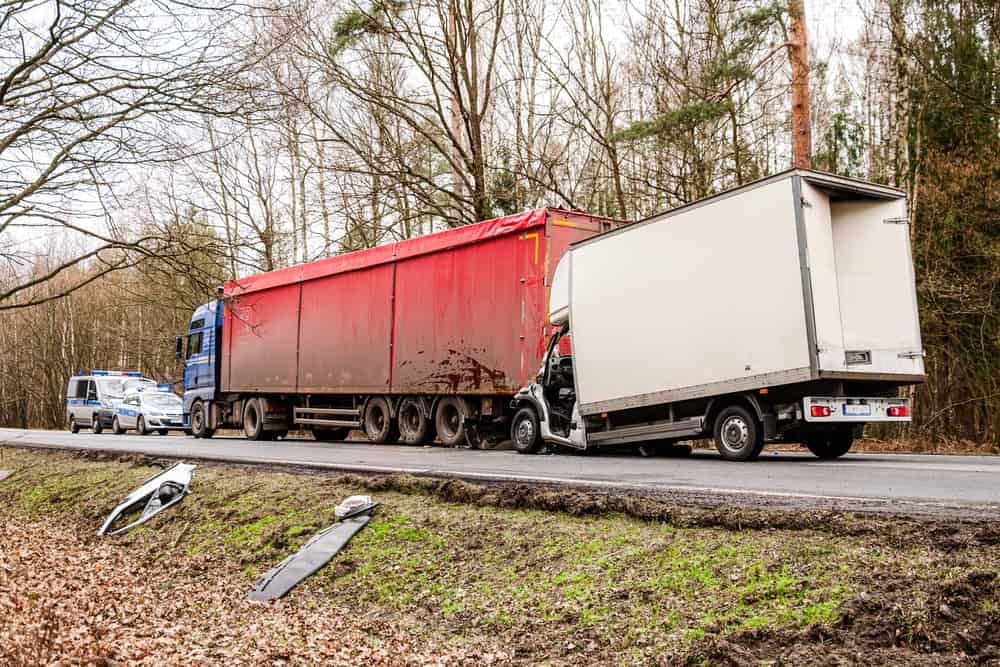
Who Bears Liability When a Commercial Truck Causes a Crash?
Truck accident claims in Michigan frequently involve more than one liable party. The truck driver is often just the starting point.
The carrier that employed or contracted the driver, the company that loaded the cargo, and the broker that arranged the haul may all share responsibility depending on the facts.
Parties that may face liability in a Sterling Heights truck accident include:
- The truck driver, for speeding, fatigue, distraction, or impairment behind the wheel
- The motor carrier, for pressuring drivers to violate hours-of-service rules or for hiring unqualified operators
- The freight broker, for selecting a carrier with a poor safety record or inadequate insurance
- The cargo loading company, for improperly securing or overloading freight that shifted during transit
- The maintenance provider, for failing to repair known mechanical defects like faulty brakes or worn tires
Identifying every liable party expands the number of insurance policies available to cover your damages.
A truck accident involving a negligent carrier and a reckless broker may open two or three separate commercial policies, each carrying higher limits than a standard auto insurance plan.
What Federal Regulations Apply to Truck Accident Claims in Michigan?
The Federal Motor Carrier Safety Administration (FMCSA) regulates commercial trucking operations across the United States. These federal rules set standards for driver qualifications, vehicle maintenance, cargo securement, and hours of service.
When a trucking company or driver violates an FMCSA regulation and that violation contributes to a crash, it strengthens the negligence case against them.
Hours-of-Service Violations
FMCSA hours-of-service regulations limit how many hours a truck driver may operate before taking a mandatory rest break.
Property-carrying drivers face an 11-hour daily driving limit within a 14-hour on-duty window, followed by a 10-hour off-duty period.
ELD data records exactly when the driver was behind the wheel and whether they exceeded those limits.
Vehicle Inspection and Maintenance Standards
FMCSA maintenance regulations require carriers to systematically inspect, repair, and maintain every commercial vehicle they operate.
Brake failures, tire blowouts, and lighting defects that contribute to crashes often trace back to missed or falsified inspection reports. Those maintenance logs become key evidence in your attorney’s liability case.
Driver Qualification Files
Every motor carrier must maintain a driver qualification file for each driver it employs.
That file includes the driver’s commercial driver’s license (CDL) status, medical certification, road test results, and employment history. Gaps in that file may indicate that the carrier hired an unqualified or medically unfit driver.
Federal regulatory violations do not automatically prove negligence in Michigan, but they provide powerful evidence that the carrier or driver failed to meet the standard of care.

How Does Michigan No-Fault Insurance Apply to Truck Accidents?
Michigan’s No-Fault insurance law applies to truck accidents the same way it applies to car crashes. Your own auto insurance pays PIP benefits for medical expenses, wage loss, and replacement services regardless of who caused the collision.
PIP Coverage After a Truck Crash
Your Personal Injury Protection (PIP) benefits come from your own auto policy, not from the trucking company’s insurance. The level of PIP coverage you carry depends on the policy you selected.
Since Michigan reformed its No-Fault law in 2019, drivers have chosen from multiple PIP tiers, and that choice directly affects how much medical coverage is available after a truck accident.
The Third-Party Claim Against the Trucking Company
If your injuries meet the serious impairment of body function threshold under MCL 500.3135, you may file a third-party liability claim against the at-fault truck driver and their employer. Given the severity of most truck crash injuries, many victims meet this standard.
Commercial trucking policies typically carry much higher coverage limits than personal auto policies. Federal law requires interstate carriers to maintain at least $750,000 in liability coverage, and many carry $1 million or more.
That higher coverage ceiling is one reason truck accident claims often produce larger recoveries than standard auto cases. Call 248-483-5000 to discuss how the insurance picture applies to your specific truck crash.
What Evidence Disappears Quickly After a Truck Accident?
Truck accident evidence degrades faster than evidence in a standard car crash because trucking companies control most of it.
ELD data, dashcam recordings, and GPS logs are stored on company-owned systems, and federal regulations only require carriers to retain some records for six months. Without a formal preservation demand from an attorney, that data may be overwritten or lost.
Evidence that your attorney must move quickly to preserve includes:
- Electronic logging device data showing the driver’s hours, speed, and route before the crash
- Dashcam or cab-mounted camera footage from the truck and nearby commercial vehicles
- The driver’s post-accident drug and alcohol test results, required by FMCSA regulations
- Pre-trip and post-trip vehicle inspection reports from the days surrounding the crash
- Dispatch communications showing what the carrier told the driver about routes, schedules, and delivery deadlines
The gap between the crash and the first preservation letter from your attorney is the most vulnerable window for evidence loss.
Trucking companies are generally required to retain certain records for limited federal time periods, but additional preservation duties may arise once a claim is anticipated or a formal request is made.
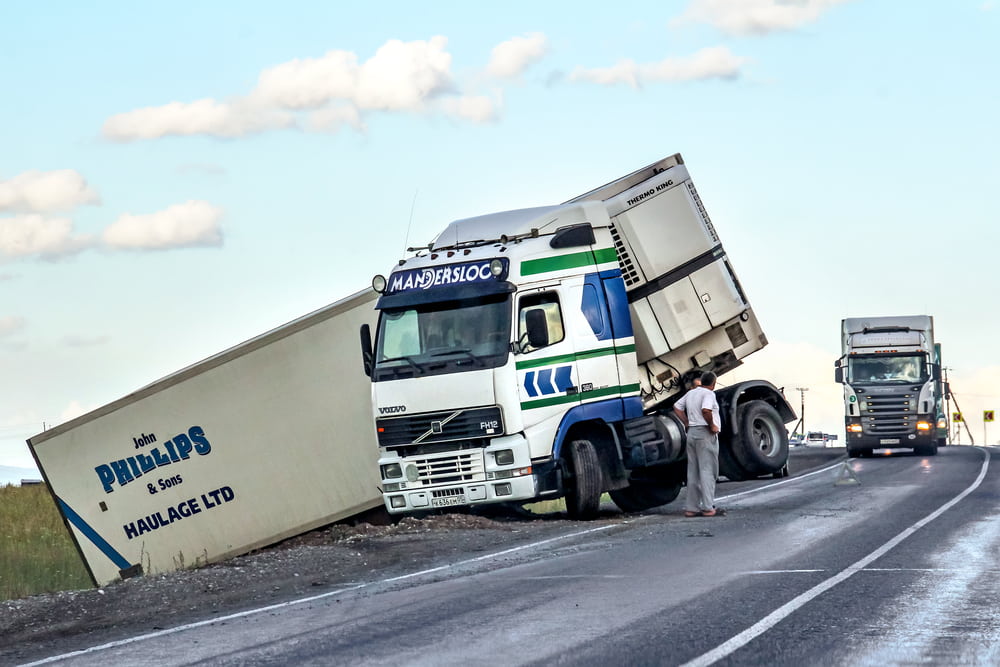
What Types of Truck Crashes Happen on Sterling Heights Roads?
Sterling Heights sits at the intersection of several major commercial vehicle corridors. M-59 connects Macomb County to I-94 and I-696, and Mound Road and Van Dyke Avenue carry steady commercial traffic through the city’s industrial and retail zones.
The mix of heavy truck volume and dense passenger vehicle traffic creates conditions for several types of collisions. Truck crash patterns common on Sterling Heights and Macomb County roads include:
- Rear-end collisions where a loaded truck fails to stop in time at congested intersections along M-59 or Hall Road
- Wide-turn accidents where a tractor-trailer cuts into adjacent lanes while turning at commercial corridor intersections
- Jackknife crashes on wet or icy roads, particularly during Michigan’s fall and winter months when stopping distances increase sharply
- Underride collisions where a passenger vehicle slides beneath the rear or side of a trailer, often resulting in catastrophic head and upper body injuries
- Cargo spill accidents caused by improperly secured loads that shift during transit and force the driver to lose control
Each crash type raises different liability questions, and the evidence needed to prove fault varies depending on whether the cause was driver error, mechanical failure, cargo loading negligence, or a combination.
FAQs for Sterling Heights Truck Accident Lawyers
Are truck accident settlements typically larger than car accident settlements?
Generally yes, truck accident settlements tend to be higher than standard car crash settlements because the injuries are more severe and commercial insurance policies carry higher coverage limits.
Federal law requires interstate trucking companies to maintain a minimum of $750,000 in liability coverage, and many carry $1 million or more. The combination of catastrophic injuries and deeper insurance coverage often results in larger total claim values.
What is the filing deadline for a truck accident lawsuit in Michigan?
Michigan’sstatute of limitations (MCL 600.5805) gives you three years from the date of the truck crash to file a personal injury lawsuit.
However, federal evidence retention periods are much shorter, and some truck data may be overwritten within months. Starting the legal process early protects both your filing rights and the electronic evidence that supports your case.
What if the truck driver was cited by police but the trucking company was not?
A police citation against the driver does not limit your claim to the driver alone. The motor carrier may face separate liability under federal regulations for hiring practices, maintenance failures, or hours-of-service violations that contributed to the crash.
Your attorney reviews the carrier’s safety record, driver qualification files, and compliance history to identify all responsible parties.
What if I was rear-ended by a delivery truck, not a semi?
You may still have a commercial vehicle accident claim even if the truck that hit you was a box truck, delivery van, or straight truck rather than a tractor-trailer.
Michigan law and FMCSA regulations apply to many types of commercial vehicles based on weight and use classification. The liable parties may include the delivery company, the driver, and potentially the company that contracted the delivery service.
Is the trucking company responsible even if the driver was an independent contractor?
Trucking companies sometimes argue that the driver was an independent contractor to avoid liability. Michigan courts and federal regulators look beyond the contract label to evaluate how much control the carrier exercised over the driver’s routes, schedules, and equipment.
If the carrier controlled those factors, it may face vicarious liability for the driver’s negligence regardless of the contractor designation.
My truck accident happened on M-59. Does the location affect which court handles the case?
A truck accident on M-59 in Sterling Heights falls within Macomb County Circuit Court jurisdiction. The location also determines which police agency responds and which local traffic records are available.
M-59 crashes involving commercial vehicles may generate additional reports from the Michigan State Police commercial vehicle enforcement division, which provides another layer of evidence for your claim.
How fast does the trucking company start building its defense after a crash?
Many large carriers activate rapid response teams within hours of a serious accident. Those teams may include company adjusters, defense attorneys, and private accident reconstruction firms.
They collect evidence, interview witnesses, and begin developing the carrier’s version of events while the injured person is still receiving medical treatment. Having your own attorney involved early counterbalances that head start.
Put a Sterling Heights Truck Accident Lawyer Between You and the Carrier’s Defense Team
The trucking company’s legal team is already working. Their adjusters are reviewing the crash report, their engineers are downloading the truck’s data, and their attorneys are preparing to minimize what the carrier pays. Every day you wait to get your own attorney involved is a day the other side builds its case unopposed.
Goodman Acker takes truck accident cases from our Sterling Heights office on a contingency fee basis. We send evidence preservation demands immediately, identify every liable party and insurance policy, and build the case with the same urgency the carrier brings to its defense.
Call 248-483-5000 and put a truck accident attorney in Sterling Heights on equal footing with the carrier’s team.

LEGALLY REVIEWED BY BARRY J. GOODMAN
Barry J. Goodman has devoted his professional life to keeping courthouse doors open for victims seeking justice. Always a tireless advocate for his own clients, Goodman sees his responsibility as a Detroit personal injury attorney in a broader sense as well. [ Attorney Bio ]


GOODMAN ACKER
Meet our Personal Injury Attorneys